What makes them move? Climate, soil and land-use influence on invertebrates distribution in Europe.
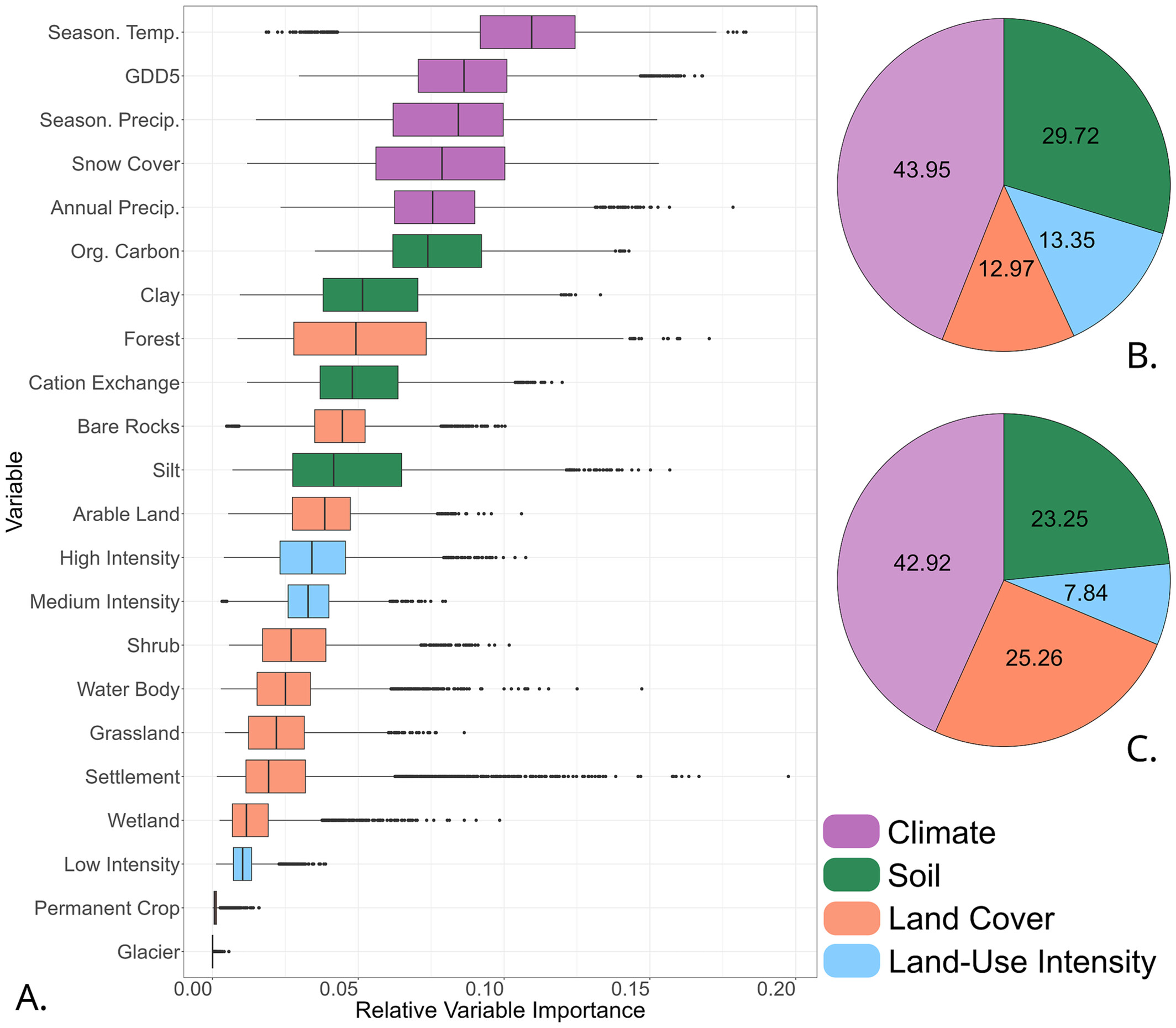
In a recent study, researchers are aiming to assess the influence of climate, soil and land-use on the distributions of terrestrial invertebrates, while also weighing their importance and consistency among cgroups, regions and land-use-intensity gradients.
The publication, titled "Continental- Scale Invertebrate Distributions Are Mainly Associated With Climate but Modulated by Soil and Land- Use Gradients", seeks to answer the following questions:
1. What is the relative contribution of climate, soil, and land- use to species distributions?
2. How do species' environmental preferences vary within and among taxonomic groups?
3. Do species' associations to environmental predictors vary across biogeographical regions and land- use intensity levels?
Using state-of-the-art species distribution modelling techniques, fine-resolution environmental data, and interpretable machine learning methods, the authors analyse over 6800 invertebrate species, spanning a broad range of taxonomic and trophic groups and biogeographical regions.
The researchers gathered more than 18 million records of where species have been observed and mapped them onto a grid of 1-km squares across Europe. They then built species distribution models, which predict where each species is likely to occur from local environmental conditions. Finally, they used an explainable AI method called SHAP (SHapley Additive exPlanations) to work out how much climate, soil, land cover and land-use intensity each contributed to those predictions.
This study makes use of several databases, among which GBIF, #Vers2022, but also project created ones - such as the ones by the EJP- Soil MINOTAUR project, project and the Safeguard project.
The authors argue that one-size-fits-all conservation prescriptions are unlikely to work, given how differently species and regions respond. They call for strategies that bring soil management and habitat restoration together, aimed at vulnerable areas and species.
The findings come amid ongoing concern over invertebrate declines across Europe. Climate change and farming intensification are widely blamed for those declines, but until now there has been little evidence comparing the two across many taxa at continental scale.
This research, published in Global Ecology and Biogeography, is supported by the Centre for the Synthesis and Analysis of Biodiversity and the MInistry of Ecological Transition of France, as well as EU funded projects NaturaConnect and OBSGESSION.
Read the full length article here.