OBSGESSION publishes a policy brief on prioritising Essential Biodiversity Variables to support European Union policy needs
The OBSGESSION project has recently published a policy brief, developed by UNEP-WCMC, a partner in the project, based on Deliverable 1.1 Policy Landscape and Needs Assessment (available in our Library and RIO collection). The document outlines a set of EBV candidates which could be used to support the EU policy needs based on the EU’s Biodiversity Strategy 2030 (EU BDS 2030). The brief will be presented for the first time during BioMonWeek next week. Stay tuned for updates on the event and the project’s participation.
The EU BDS 2030 is an approach developed by the EU for protecting nature and preventing the degradation of ecosystems. The approach aims to put Europe’s biodiversity on a path to recovery by 2030 and thus provide support for people, climate and the planet. Part of the plan for achieving this objective is a set of 102 actions and sub-actions committed to by the EU and its Member States. Those actions portray an entry point where Essential Biodiversity Variables (EBVs) could be used to assist the execution of the EU BDS 2030.
EBVs, according to relevant references cited in the brief, are structured frameworks for managing, monitoring and reporting biodiversity changes. They could allow the generation of indicators to notify implementation, reporting, the review process and policy planning. Under the OBSGESSION project, UNEP-WCMC has carried out an assessment to identify priority EBV candidates which would support EU policy needs based on the EU BDS 2030. The recognised ‘EBV-applicable’ actions and indicators have been categorised in classes and candidates, where those with a higher number of actions and indicators (overall and within different ecosystem realms and stages) were considered the highest policy priority (Figure 1).
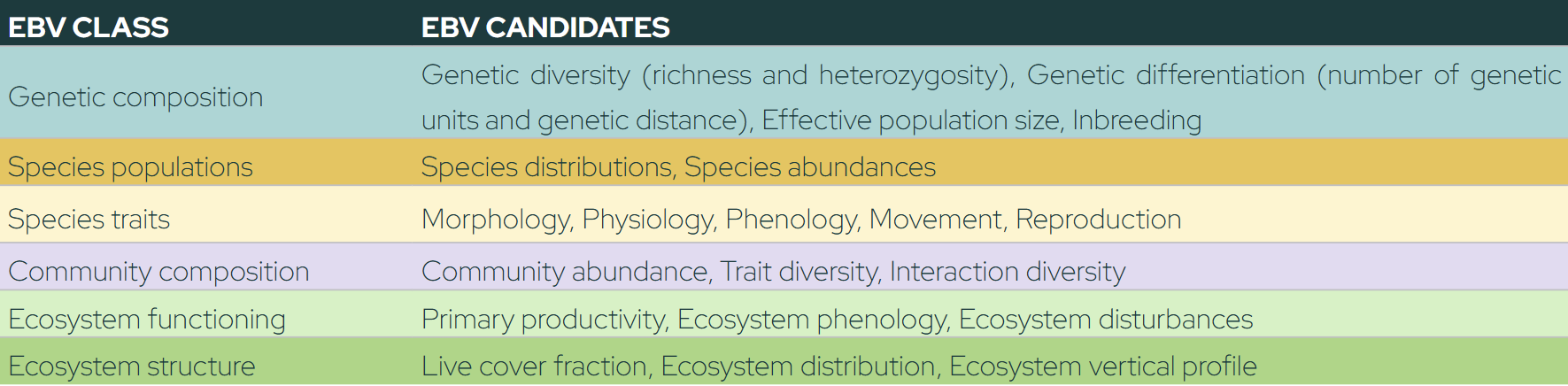 Figure 1. Figure 1.
|
The identified EBVs, out of the 102 actions and sub-actions, were 37, and they were considered relevant to monitor 5 out of 16 indicators from the Dashboard (a KCBD tool for monitoring the progress towards executing EU BDS 2030). Generally, the top-ranked EBVs were under the species population and ecosystem structure classes. This means that they have been identified as relevant for meeting EU policy needs and helping to define EBV data products under OBSGESSION.
In order to expand on this and to refine the mapping and prioritisation of EBVs, based on EU policy needs, this assessment is expected to be expanded through OBSGESSION’s life cycle. An update of Deliverable 1.1 Policy Landscape and Needs Assessment will be submitted in June this year.
Read the full policy brief in our Library and RIO collection.